Показ дописів із міткою life. Показати всі дописи
Показ дописів із міткою life. Показати всі дописи
вівторок, 15 березня 2011 р.
Biutiful
Not to exaggerate, I'd call it the first honest and kind (even despite of some cruel scenes) movie that I saw for several past years. Many thanks to Sr Alejandro González Iñárritu.

середа, 3 листопада 2010 р.
I wonder how many opportunities we lose by throwing away ideas or deeds that we consider unpromising. Sometimes these considerations are based on our complexes, sometimes on our experience, and I cannot say which reason is worse. In any case, while complexes are something that is a bit out of control of an average man, experience is more or less a cognitive substance. A man with huge experience is somewhat similar to an expert system; they maintain a knowledgebase of various statements along with a set of possible ways of their resolution. As a matter of fact, that feature of experience makes life simpler, as it allows to automate many aspects of life; instead of thinking over yet another use case, a man "contacts" his experience database and gets the known pattern for that use case.
What is bad, is that these specifics of our mind prevent us from doing irrational things. It is hard to run something unusual and exotic, as our experience raises both its hands up and shouts "No, buddy, this activity never used to be successful in the past, so what the hell are you expecting from it now? Stop and do something well-tried". As a trivial example, we will never go shopping on Sunday, as our experience tells us that the stores are all closed (and may miss some attractive Sunday offer). This doesn't look reasonable to me.
Our world does not encourage rational way of living; luck and randomness have a great effect on our life. People living in a rational way are doomed to flow together with the common stream, as the factor of randomness is rarely present in a rational life (of course, there are exceptions). As minds of different people are more or less similar to each other (of course, there are exceptions), one will not be able to outrun the crowd acting in the same way as the crowd. By acting irrationally, one brings some randomness and luck into his life (by exploiting the chances that are ignored by the others, rationally-acting people), increasing the probability of catching the faster train.
What is bad, is that these specifics of our mind prevent us from doing irrational things. It is hard to run something unusual and exotic, as our experience raises both its hands up and shouts "No, buddy, this activity never used to be successful in the past, so what the hell are you expecting from it now? Stop and do something well-tried". As a trivial example, we will never go shopping on Sunday, as our experience tells us that the stores are all closed (and may miss some attractive Sunday offer). This doesn't look reasonable to me.
Our world does not encourage rational way of living; luck and randomness have a great effect on our life. People living in a rational way are doomed to flow together with the common stream, as the factor of randomness is rarely present in a rational life (of course, there are exceptions). As minds of different people are more or less similar to each other (of course, there are exceptions), one will not be able to outrun the crowd acting in the same way as the crowd. By acting irrationally, one brings some randomness and luck into his life (by exploiting the chances that are ignored by the others, rationally-acting people), increasing the probability of catching the faster train.
субота, 16 жовтня 2010 р.
субота, 9 жовтня 2010 р.
субота, 2 жовтня 2010 р.
Black Cat
Several days ago I was walking down the street. One middle-aged lady carrying two heavy bags in her hands appeared far ahead. We were walking towards each other, getting closer and closer, when suddenly a black cat appeared in the middle of the distance between us and began to cross the street.
I really love cats, you know, I like to talk to them, that's why I smiled when I saw her and accelerated a bit to take a closer look (she was a beautiful shiny one). Suddenly the lady raced on, panting and shaking her enormous bags as if they were two fan blades. I was a bit confused at first, but in a moment I got the idea. Some people in our country consider black cat as a sign of bad luck. If one crosses your way, something bad and terrible will reach you sooner or later. That's why they try to omit such situations wherever possible. The lady happened to succeed in her undertaking, and the frightened cat failed to reach the opposite side of the street and jumped out to the bush. Having the victory in her hands, the lady put her bags on the ground and stopped, continuing to pant. Obviously, she has just rescued herself from a mortal danger.
I was thinking about different sides of this situation on my further way home. First, it appears that we have more signs of bad luck than signs of good luck. Moreover, bad luck signs are much more ordinary, easy-to-come-across ones. Bad luck is guaranteed by broken mirrors, ladders, empty buckets, Friday 13s, scattered salt, ravens, owls, left feet and that poor black cat. Good luck by four-leaf clover (anybody seen that?), horseshoes, coins found on street, rainbows, ladybugs... is that all?
Second, there is no problem in trapping into something bad. Lack of attention, misunderstanding, memory failures, wrong estimations and simply a bad mood often lead to unpleasant consequences that can be treated as caused by bad luck. Life ain't easy, and in many situations we get not what we expect to. It is natural for a man to be mistaken, but those mistakes are often considered as a crook in the lot.
So what we have? We have a huge number of bad luck signs and are open to various bad things due to the nature of our world. There is a high probability that another fault comes soon after a sign of bad luck... confirming the latter. Good luck signs are just too rare to affect something. A good environment to build a loser from everyone.
Thence, accepting bad luck signs is a wrong strategy. Instead, it is reasonable to invent various good luck signs and let them make you think positively. The bad things are going to occur independently of whether there were bad luck signs or there weren't; and the good luck signs bring you in good mood, making you feel confident and easy. Luck is something that can be built, and we should care about building it in the right way.
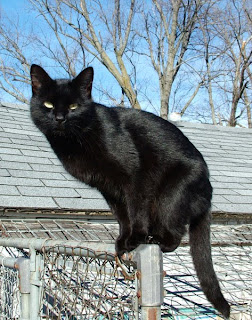
I really love cats, you know, I like to talk to them, that's why I smiled when I saw her and accelerated a bit to take a closer look (she was a beautiful shiny one). Suddenly the lady raced on, panting and shaking her enormous bags as if they were two fan blades. I was a bit confused at first, but in a moment I got the idea. Some people in our country consider black cat as a sign of bad luck. If one crosses your way, something bad and terrible will reach you sooner or later. That's why they try to omit such situations wherever possible. The lady happened to succeed in her undertaking, and the frightened cat failed to reach the opposite side of the street and jumped out to the bush. Having the victory in her hands, the lady put her bags on the ground and stopped, continuing to pant. Obviously, she has just rescued herself from a mortal danger.
I was thinking about different sides of this situation on my further way home. First, it appears that we have more signs of bad luck than signs of good luck. Moreover, bad luck signs are much more ordinary, easy-to-come-across ones. Bad luck is guaranteed by broken mirrors, ladders, empty buckets, Friday 13s, scattered salt, ravens, owls, left feet and that poor black cat. Good luck by four-leaf clover (anybody seen that?), horseshoes, coins found on street, rainbows, ladybugs... is that all?
Second, there is no problem in trapping into something bad. Lack of attention, misunderstanding, memory failures, wrong estimations and simply a bad mood often lead to unpleasant consequences that can be treated as caused by bad luck. Life ain't easy, and in many situations we get not what we expect to. It is natural for a man to be mistaken, but those mistakes are often considered as a crook in the lot.
So what we have? We have a huge number of bad luck signs and are open to various bad things due to the nature of our world. There is a high probability that another fault comes soon after a sign of bad luck... confirming the latter. Good luck signs are just too rare to affect something. A good environment to build a loser from everyone.
Thence, accepting bad luck signs is a wrong strategy. Instead, it is reasonable to invent various good luck signs and let them make you think positively. The bad things are going to occur independently of whether there were bad luck signs or there weren't; and the good luck signs bring you in good mood, making you feel confident and easy. Luck is something that can be built, and we should care about building it in the right way.

пʼятниця, 24 вересня 2010 р.
пʼятниця, 17 вересня 2010 р.
There are two major vectors in today's social and economical life:
1) the population is steadily growing,
2) most of the businesses invest in automation in order to reduce their operational costs.
These vectors are opposite to each other. The result of these tendencies is that with the years we have more potential workers but less positions that could help employ all of them. That's why the unemployment rate peaks we notice today are not the highest ones.
In further perspective, new unemployed's (apparently the ones with lower mental skills, who are generally dismissed by the automation process), will be forced to migrate to less developed regions of the planet to apply their skills there, making the gap between the developed and third-world countries larger. Finally, the things will become irreversible, so third-world states will lose any chance to outrun the developed ones. None of the possible consequences of that world setup makes me happy.
A solution that might prevent this kind of future is to invent an extremely labour-consuming activity that will help to give a job to those millions of workers. This can be Moon or Mars expansion, or world-wide greenery planting program for example. Space investigation is a preferred one, as exploration of neighbour planets will also assist to overcome the overpopulation problem.
1) the population is steadily growing,
2) most of the businesses invest in automation in order to reduce their operational costs.
These vectors are opposite to each other. The result of these tendencies is that with the years we have more potential workers but less positions that could help employ all of them. That's why the unemployment rate peaks we notice today are not the highest ones.
In further perspective, new unemployed's (apparently the ones with lower mental skills, who are generally dismissed by the automation process), will be forced to migrate to less developed regions of the planet to apply their skills there, making the gap between the developed and third-world countries larger. Finally, the things will become irreversible, so third-world states will lose any chance to outrun the developed ones. None of the possible consequences of that world setup makes me happy.
A solution that might prevent this kind of future is to invent an extremely labour-consuming activity that will help to give a job to those millions of workers. This can be Moon or Mars expansion, or world-wide greenery planting program for example. Space investigation is a preferred one, as exploration of neighbour planets will also assist to overcome the overpopulation problem.
пʼятниця, 10 вересня 2010 р.
We often think unfamiliar people to be better than they actually are... just because we only see the good side of them. There is also the bad side that is hidden from public and visible only to closer people.
In exactly the same way, we often consider unfamiliar people to be worse than they are just because their visible side is their bad side.
In exactly the same way, we often consider unfamiliar people to be worse than they are just because their visible side is their bad side.
понеділок, 16 серпня 2010 р.
Books
The cover of the latest Time issue contains a photo of Jonathan Franzen accompanied with the following message:
Great American Novelist. He's not the richest or most famous. His characters don't solve mysteries, have magical powers or live in the future. But in his new novel, Freedom, Jonathan Franzen shows us the way we live now.
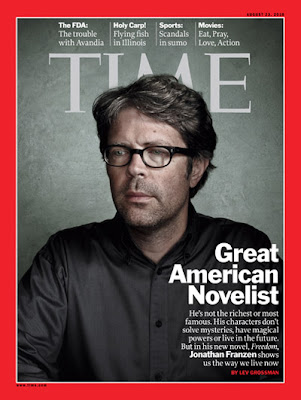
The fact that the person placed on the Time's cover is a living novel writer was so surprising, that a number of other media sources dedicated a news entry for it. It appeared that Jonathan Franzen is the first writer for 10 years to get to the cover of this magazine (the previous one was Stephen King in 2000).
In my opinion, this fact is not a worse illustration of the way we live now than the mentioned book. For 50 years (1951-2000) as many as 42 living writers were honoured to get to the Time's cover, ~8 authors per decade. The first decade of 2000's was not that rich. However, I cannot say that the shelves of bookstores have become smaller. Conversely, they obviously have become much larger than ten years ago. And the books have become much more colourful and pretty than before (right now I'm looking at my good old Catcher in the Rye, 1975 edition, and I'm sure it would have never been sold in today's bookstore due to its ugly cover).
The abundance on the bookshelves hides the scarcity of modern literature. It is the same entropy loss problem I wrote about some time ago. The problem is that we produce a lot of form, while forgetting about the sense. A typical book available in a store today is nothing more than a coloured pack of printed paper whose life is limited by a trip from New York to San Francisco. What a difference to my Catcher, the Catcher I've bought at bibliopole's, whose pages become yellow with time, who has some wrested pages pasted back in wrong order, who spent his best years being read by a dozen of my friends (and their friends), and who is still alive and carefully dusted once a week on a dedicated bookcase shelf, waiting for succeeding readers.
Great American Novelist. He's not the richest or most famous. His characters don't solve mysteries, have magical powers or live in the future. But in his new novel, Freedom, Jonathan Franzen shows us the way we live now.

The fact that the person placed on the Time's cover is a living novel writer was so surprising, that a number of other media sources dedicated a news entry for it. It appeared that Jonathan Franzen is the first writer for 10 years to get to the cover of this magazine (the previous one was Stephen King in 2000).
In my opinion, this fact is not a worse illustration of the way we live now than the mentioned book. For 50 years (1951-2000) as many as 42 living writers were honoured to get to the Time's cover, ~8 authors per decade. The first decade of 2000's was not that rich. However, I cannot say that the shelves of bookstores have become smaller. Conversely, they obviously have become much larger than ten years ago. And the books have become much more colourful and pretty than before (right now I'm looking at my good old Catcher in the Rye, 1975 edition, and I'm sure it would have never been sold in today's bookstore due to its ugly cover).
The abundance on the bookshelves hides the scarcity of modern literature. It is the same entropy loss problem I wrote about some time ago. The problem is that we produce a lot of form, while forgetting about the sense. A typical book available in a store today is nothing more than a coloured pack of printed paper whose life is limited by a trip from New York to San Francisco. What a difference to my Catcher, the Catcher I've bought at bibliopole's, whose pages become yellow with time, who has some wrested pages pasted back in wrong order, who spent his best years being read by a dozen of my friends (and their friends), and who is still alive and carefully dusted once a week on a dedicated bookcase shelf, waiting for succeeding readers.
неділя, 15 серпня 2010 р.
A major difference between USSR and western rock music of 60-80's is that most of the Russian bands never really cared about the music (yes, I know that USSR != Russia, but as the majority of the bands sang songs in Russian, I will use that term). There were many reasons for that. There were no money, there were no good instruments, there were no good recording equipment. There were no sponsors. There were no local musical heritage, and getting discs with western music was a challenge.
However, even though the music was recorded on handicraft hardware built from spare parts of three different machines, even though the guitars and processors sounded as a mix of Nirvana, Chuck Berry and Bach, even though a drum machine beat the same boring 4/4 far-from-reality rhythm through entire song, even though guitar solos were as simple as in guitar beginner's guide, even though the rehearsals were performed at someone's apartments or (in better case) in underground studios, even though in many cases there were no official discs available, so the listeners had to use their tape recorders to spread records, even though... Despite all of that, Russian bands played the rockest rock I've ever listened to. Every single song was an inexhaustible source of energy, love, truth and wisdom. It may sound oddly, but probably the poor quality of the music was one of the compartments of the inspiration made by the songs... Good enough music would just have prevented the listener from feeling the spirit they carried.
However, even though the music was recorded on handicraft hardware built from spare parts of three different machines, even though the guitars and processors sounded as a mix of Nirvana, Chuck Berry and Bach, even though a drum machine beat the same boring 4/4 far-from-reality rhythm through entire song, even though guitar solos were as simple as in guitar beginner's guide, even though the rehearsals were performed at someone's apartments or (in better case) in underground studios, even though in many cases there were no official discs available, so the listeners had to use their tape recorders to spread records, even though... Despite all of that, Russian bands played the rockest rock I've ever listened to. Every single song was an inexhaustible source of energy, love, truth and wisdom. It may sound oddly, but probably the poor quality of the music was one of the compartments of the inspiration made by the songs... Good enough music would just have prevented the listener from feeling the spirit they carried.
середа, 11 серпня 2010 р.
No wrong no right,
I'm gonna tell you there's no black and no white.
Queen, "One Vision"
A small addition to the previous post.
Dividing people (and other things) into black and white on the basis of some particular feature of them is one of the biggest mistakes one can make. Unfortunately, our mind is lazy. It is much easier for us to sort a hundred elements out into two (three, four, ten) groups by some common criteria and operate with those N groups, than to put each one to a separate personal group and deal with 100 groups instead. Sometimes this is called abstracting. Naturally, abstracting is good when used in maths or biology, but it distorts our vision when applied to real-world or social stuff.
Sometimes this feature of our mind is exploited by unfair people. The teams of candidates of presidential/governmental races often try to blacken the opposite candidate by showing them as adulterer, a person of doubtful character and so on. Well, it is difficult for me to understand the relation between PM's sexual temperament and their economical and manager's skills (needed for the state to prosper).
I try to classify the things as vectors of different essential properties. For instance, a typical vector of a person is (name, sex, age, sense of humour (1-10), kindness (1-10), intellectual level (-1-10), positiveness (1-10), honesty, appearance, physical skills, risk-ability, ..., smoking (yes/no), ...). This relates to all people, not only to friends (politics have some of the properties grayed, e.g. honesty ;)). The properties are mostly orthogonal, and thus such classification helps not to sort people into black and white, stupid and clever, or honest and dishonest. Really, there are quite a few properties to consider, and the presence of negative ones does not mean the absence of positive ones.
пʼятниця, 23 липня 2010 р.
When I was younger, I did not like smoking girls. The fact that the girl smokes was quite definitive for me; every such girl used to immediately get to the "black list" (or "uninteresting person list", no matter) without any possibility of becoming a close person in future. I don't know the exact origins of such attitude; it is likely to have been built from a number of sources including viewpoints introduced by the parents, books, movies and own [poor] experience.
However, the attitude has changed drastically when I was about 16. I was forced to spend a continuous period of time with a girl who smoked hard. Though the girl obviously had to get to the "black list" at once, she was someone quite different from all the smoking girls I have ever met. Actually, in all other aspects she was very close to my understanding of what the ideal woman should be like. That was really a challenge, something to what practicing psychologists often refer as a "pattern breach".
That case made me reconsider my viewpoints a lot. Basically, it has given me an understanding of two things, (1) it is stupid and extremely unwise to sort out people and things into black and white just on the basis of their particular feature or features, (2) if something does not fit into the existing viewpoint, it is very likely that the viewpoint is wrong and should be revised. Since then I am trying to be more liberal and intelligent when forming my opinion on particular person or object.
Really, being too unloyal is non-productive and even insulting sometimes. Don't you hate your neighbour just because he snores too loudly at night? Hasn't your coworker become an enemy for you just because he always occupies your parking place? Haven't you stopped buying goods in a nearby supermarket just because a cashier has once shortchanged you?
You know, snoring is always a symptom of some disease. The neighbour does not snore intentionally to annoy you; he is likely just not be unaware of such "feature" of his organism. He is also likely to be a smart and friendly person in all other aspects. The coworker is likely not to know that you have chosen that parking place for yourself, in turn, he also dislikes you because you are occupying "his" place. The SM cashier might have had a sleepless night that day because of her daughter's school exam and just got mistaken when calculating the change. Yet, a smoking girl is neither a devil nor a criminal. (Yes, most of the criminals are smokers, but you can hardly state the opposite). Maybe, each of them is worth giving 'em a chance?
However, the attitude has changed drastically when I was about 16. I was forced to spend a continuous period of time with a girl who smoked hard. Though the girl obviously had to get to the "black list" at once, she was someone quite different from all the smoking girls I have ever met. Actually, in all other aspects she was very close to my understanding of what the ideal woman should be like. That was really a challenge, something to what practicing psychologists often refer as a "pattern breach".
That case made me reconsider my viewpoints a lot. Basically, it has given me an understanding of two things, (1) it is stupid and extremely unwise to sort out people and things into black and white just on the basis of their particular feature or features, (2) if something does not fit into the existing viewpoint, it is very likely that the viewpoint is wrong and should be revised. Since then I am trying to be more liberal and intelligent when forming my opinion on particular person or object.
Really, being too unloyal is non-productive and even insulting sometimes. Don't you hate your neighbour just because he snores too loudly at night? Hasn't your coworker become an enemy for you just because he always occupies your parking place? Haven't you stopped buying goods in a nearby supermarket just because a cashier has once shortchanged you?
You know, snoring is always a symptom of some disease. The neighbour does not snore intentionally to annoy you; he is likely just not be unaware of such "feature" of his organism. He is also likely to be a smart and friendly person in all other aspects. The coworker is likely not to know that you have chosen that parking place for yourself, in turn, he also dislikes you because you are occupying "his" place. The SM cashier might have had a sleepless night that day because of her daughter's school exam and just got mistaken when calculating the change. Yet, a smoking girl is neither a devil nor a criminal. (Yes, most of the criminals are smokers, but you can hardly state the opposite). Maybe, each of them is worth giving 'em a chance?
пʼятниця, 16 липня 2010 р.
It is very exciting to fight with your own mind. My today has begun with a bunch of minor and major negatives. First, I failed to get in time to a bus to carry me to a gym (20 seconds is not a delay for an appointment but they are vital when you are trying to catch a bus ;)); the subsequent bus had no free seats, so in addition I have lost 30 minutes of morning reading. Finally having got off the bus (the driver obviously used to drive road rollers in his best years), I found one of the pedestrian traffic lights on my further way broken, resulting in yet another 5(000) minutes of waiting for traffic to let me cross the street. And it was only 7:15.
The dawning day gave me another missed-on-the-edge bus, enormous queue in a bank, broken lock of the outer door, discharged battery on the mobile, and three or four broken or postponed (for various reasons) work plans.
Yet going in the first bus, I understood that it’s simply an another “unlucky day”. Such days - consisting of a shower of misfortunes and sad mistakes - occur from time to time, and in most cases I just accept them as they are, trying to avoid doing complex or critical tasks. However, for some reason I decided to fight my mind today and to do my best to remove the “unlucky” sticker from the day :).
So, having got off the bus I began to search for positive stuff around to fix my karma. Funny dogs in a park, clear blue skies, an accidental green wave I’ve got into, a small smiling girl didn’t help. Next, mad race in a gym to squeeze negative energy out of my mind. A little better, but still far from the ideal. Okay, 10 minutes of relaxed park walk; an exchange of smiles with an ice-cream seller (I’ve tried all the sellers around); another chapter of a book; a cold shower; some funny Internet stuff. Nope. Fixed door lock. No avail...
And finally I did it! To be exact, the sound of acoustic guitar, harmonica and Bob Dylan’s voice coming from my PC’s speakers did that. And the mind has suddenly become clean and positive; I realised that it would be even better to alter the work plans in the way I was forced to do in the morning, and there’s nothing fatal in missed buses and absence of habitual morning book. I also realised that I’ve just lived (and continue to live, as it was something about noontime) a brand new day of my life, - a wonderful day, full of new experience, knowledge and feelings. You bet, I have just fought down my own mind!
The dawning day gave me another missed-on-the-edge bus, enormous queue in a bank, broken lock of the outer door, discharged battery on the mobile, and three or four broken or postponed (for various reasons) work plans.
Yet going in the first bus, I understood that it’s simply an another “unlucky day”. Such days - consisting of a shower of misfortunes and sad mistakes - occur from time to time, and in most cases I just accept them as they are, trying to avoid doing complex or critical tasks. However, for some reason I decided to fight my mind today and to do my best to remove the “unlucky” sticker from the day :).
So, having got off the bus I began to search for positive stuff around to fix my karma. Funny dogs in a park, clear blue skies, an accidental green wave I’ve got into, a small smiling girl didn’t help. Next, mad race in a gym to squeeze negative energy out of my mind. A little better, but still far from the ideal. Okay, 10 minutes of relaxed park walk; an exchange of smiles with an ice-cream seller (I’ve tried all the sellers around); another chapter of a book; a cold shower; some funny Internet stuff. Nope. Fixed door lock. No avail...
And finally I did it! To be exact, the sound of acoustic guitar, harmonica and Bob Dylan’s voice coming from my PC’s speakers did that. And the mind has suddenly become clean and positive; I realised that it would be even better to alter the work plans in the way I was forced to do in the morning, and there’s nothing fatal in missed buses and absence of habitual morning book. I also realised that I’ve just lived (and continue to live, as it was something about noontime) a brand new day of my life, - a wonderful day, full of new experience, knowledge and feelings. You bet, I have just fought down my own mind!
четвер, 8 липня 2010 р.
Our knowledge or, to be accurate, the part of our knowledge responsible for subjective information, is mostly wrong. Our knowledge is being constantly formed by the sources that produce highly distorted information that is often based on assumptions of the authors, false or even counterfeited facts. In many cases only side aspects of the whole picture is presented.
The dissonance between the “real” reality and the reality that is forcibly being boxed up into our minds has increased drastically with the overall commercialisation of the society. News is not a source of up-to-date information anymore, it is a commercial product that is positioned on global or local markets of “news receivers”. Led by the main idea of capitalistic economics, the competition, news companies are forced to run after fun, not after essence. It is more important to have weather forecast presented by a hot blonde in mini rather than to provide accurate temperature values for tomorrow (I have nothing against the blonde herself, even the other way round, yet the *main* purpose of a forecast is informing about correct weather). In order to make information acceptable by as wide set of “news receivers” as possible, the facts are often brushed and beautified to exploit baser instincts at the expense of actuality.
Actually, it is hard to blame news companies for this, as they are just doing their business. Those who do not adhere to the general stream will be knocked down and substituted by the others who will do.
What is sad, is that “thanks” to our oversimplified and running-for-sensations world, we stick to false ideals, we hail losers (or common people in best case) and are not aware of real heroes. The “real” reality has nothing to do with the things propagated. There are no fairy adventures and heroes on white horses, live-for-today’s and good-vs-evil’s, 90-60-90’s and 23-years-old-sexy-nuclear-physics-professors; the real reality is boring and mostly undistinguished, but whom such reality would be interesting to? Pop is king.
Obviously, this cannot last forever. While not being able to discover it today, the people will definitely notice the difference between what they watch, hear or read around and what they see with their eyes. But what would be the price?
The dissonance between the “real” reality and the reality that is forcibly being boxed up into our minds has increased drastically with the overall commercialisation of the society. News is not a source of up-to-date information anymore, it is a commercial product that is positioned on global or local markets of “news receivers”. Led by the main idea of capitalistic economics, the competition, news companies are forced to run after fun, not after essence. It is more important to have weather forecast presented by a hot blonde in mini rather than to provide accurate temperature values for tomorrow (I have nothing against the blonde herself, even the other way round, yet the *main* purpose of a forecast is informing about correct weather). In order to make information acceptable by as wide set of “news receivers” as possible, the facts are often brushed and beautified to exploit baser instincts at the expense of actuality.
Actually, it is hard to blame news companies for this, as they are just doing their business. Those who do not adhere to the general stream will be knocked down and substituted by the others who will do.
What is sad, is that “thanks” to our oversimplified and running-for-sensations world, we stick to false ideals, we hail losers (or common people in best case) and are not aware of real heroes. The “real” reality has nothing to do with the things propagated. There are no fairy adventures and heroes on white horses, live-for-today’s and good-vs-evil’s, 90-60-90’s and 23-years-old-sexy-nuclear-physics-professors; the real reality is boring and mostly undistinguished, but whom such reality would be interesting to? Pop is king.
Obviously, this cannot last forever. While not being able to discover it today, the people will definitely notice the difference between what they watch, hear or read around and what they see with their eyes. But what would be the price?
неділя, 20 червня 2010 р.
When opportunities choose us
On August 20, 2008 an MD-82 airplane performing a JK5022 (Madrid-Las Palmas) flight has failed to take off from Madrid-Barajas airport, fell down and exploded. 154 of 172 passengers and crew members were killed. The further investigation has shown that the accident has been caused by a sequence of pilots’ and technicians’ mistakes. The fatal mistake, the one that actually was an immediate reason for the crash, was an attempt to take off with slats and flaps closed.
A very similar case (and happily, not a “very similar accident”) has happened in that very Spain a year before the Barajas crash. On June 5, 2007 an MD-83 airplane performing Lanzarote-Barcelona flight had been a subject for exactly the same bunch of staff mistakes, and also attempted to take off with closed flaps. Fortunately, there was a strong headwind; besides, the aircraft was slightly underloaded. Because of these two factors the machine succeeded in reaching the necessary lift that let it have avoided the JK5022 fate. The crew and the passengers had to experience several seconds of drastic 60 degrees right and left rolls though.
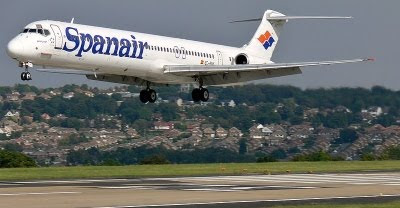
Generally, an aircraft taking off with its flaps closed does not have a chance to climb. That is, the passengers of MD-83 have been sentenced to death when they checked in to the flight in Lanzarote (or when they were booking the tickets, or ... who knows when exactly they’ve been, never mind). But the environment -- someone might wish to call it fortune, destiny, God, weather, closed system, whatever -- just has given them a minute opportunity to survive.
A good case to recall when you will be blaming the piercing wind that has blown your hat away.
A very similar case (and happily, not a “very similar accident”) has happened in that very Spain a year before the Barajas crash. On June 5, 2007 an MD-83 airplane performing Lanzarote-Barcelona flight had been a subject for exactly the same bunch of staff mistakes, and also attempted to take off with closed flaps. Fortunately, there was a strong headwind; besides, the aircraft was slightly underloaded. Because of these two factors the machine succeeded in reaching the necessary lift that let it have avoided the JK5022 fate. The crew and the passengers had to experience several seconds of drastic 60 degrees right and left rolls though.

Generally, an aircraft taking off with its flaps closed does not have a chance to climb. That is, the passengers of MD-83 have been sentenced to death when they checked in to the flight in Lanzarote (or when they were booking the tickets, or ... who knows when exactly they’ve been, never mind). But the environment -- someone might wish to call it fortune, destiny, God, weather, closed system, whatever -- just has given them a minute opportunity to survive.
A good case to recall when you will be blaming the piercing wind that has blown your hat away.
субота, 12 червня 2010 р.
Opportunities
It is hard to imagine how many opportunities we miss in our lives just because of our passiveness. Some of those opportunities could have made our lives more interesting, sensible and happy, helping us to reach higher peaks. What is clear for me is that the life flow is not a well-defined thing; conversely, it is quite unstable and highly detail-dependent. Though the socium stimulates an iterative and more or less steady way of life (school, high school, university, then building a career brick-by-brick...), this one is obviously not the best one. Yes, it is really not that bad, as it provides some stability and makes you confident in your future... a future of a yet another average man or woman.
The thing that comes to my mind is that the iterative way is ideal for passive persons. It just lets you drift with the flow, with minimal movements required from your side (as a side effect, this system does not accept active persons, having various insulting words such as upstarts and careerists to refer to them; Russians even have a proverb stating that “the initiative leads to punishment”).
At the same time, every day gives us a number of opportunities -- big or small, residing near or far, promising or with almost no evident output. In many cases those opportunities are hard to observe, but even being discovered, they require us to leave our cozy shell and do something unusual to catch them. Strikingly, but most of the people tend to stay in their shells even if they do see those opportunities. In some cases there is no reason to blame them, as catching opportunities may result in loss of stability of their current lifeflows (which is the core of life model propagated by the socium). However, the other opportunities are ignored for totally different reasons... For our scares, first of all. We refuse to suggest our revolutionary ideas to the director because we are afraid of his skepticism; we have to lock our manuscripts in the drawer because we do not consider them to worth a penny; we miss a chance to dance with a girl at a prom because we are afraid of being kicked off... Yes, it is completely possible that the director will tear your ideas down, the editor will send your stories back, and that blue-eyed girl will just laugh at you... But at least you will be confident that you did everything you could. Yes, the romance failed. But was it possible at all if you just have preferred to have another beer?
Being active and catching positive opportunities is vital for putting yourself above the average line.
The thing that comes to my mind is that the iterative way is ideal for passive persons. It just lets you drift with the flow, with minimal movements required from your side (as a side effect, this system does not accept active persons, having various insulting words such as upstarts and careerists to refer to them; Russians even have a proverb stating that “the initiative leads to punishment”).
At the same time, every day gives us a number of opportunities -- big or small, residing near or far, promising or with almost no evident output. In many cases those opportunities are hard to observe, but even being discovered, they require us to leave our cozy shell and do something unusual to catch them. Strikingly, but most of the people tend to stay in their shells even if they do see those opportunities. In some cases there is no reason to blame them, as catching opportunities may result in loss of stability of their current lifeflows (which is the core of life model propagated by the socium). However, the other opportunities are ignored for totally different reasons... For our scares, first of all. We refuse to suggest our revolutionary ideas to the director because we are afraid of his skepticism; we have to lock our manuscripts in the drawer because we do not consider them to worth a penny; we miss a chance to dance with a girl at a prom because we are afraid of being kicked off... Yes, it is completely possible that the director will tear your ideas down, the editor will send your stories back, and that blue-eyed girl will just laugh at you... But at least you will be confident that you did everything you could. Yes, the romance failed. But was it possible at all if you just have preferred to have another beer?
Being active and catching positive opportunities is vital for putting yourself above the average line.
четвер, 3 червня 2010 р.
Eat me!
One of my [ten thousands] favourite pieces in Alice in Wonderland:
Soon her eye fell on a little glass box that was lying under the table: she opened it, and found in it a very small cake, on which the words `EAT ME' were beautifully marked in currants. `Well, I'll eat it,' said Alice, `and if it makes me grow larger, I can reach the key; and if it makes me grow smaller, I can creep under the door; so either way I'll get into the garden, and I don't care which happens!'
She ate a little bit, and said anxiously to herself, `Which way? Which way?', holding her hand on the top of her head to feel which way it was growing, and she was quite surprised to find that she remained the same size: to be sure, this generally happens when one eats cake, but Alice had got so much into the way of expecting nothing but out-of-the-way things to happen, that it seemed quite dull and stupid for life to go on in the common way.
It is an outstanding illustration of two things:
1) How our mind can be confused with a sequence of unusual events. Having eaten the cake the day before, Alice would have never expected it to have something to do with her size.
2) How our mind can be constrained by our past experience. Alice expected the cake to make her smaller or bigger, but never expected it to cast her to a bird or a fish (or to force rain to fall from the sky), just because of her prior experience with a bottle.
Soon her eye fell on a little glass box that was lying under the table: she opened it, and found in it a very small cake, on which the words `EAT ME' were beautifully marked in currants. `Well, I'll eat it,' said Alice, `and if it makes me grow larger, I can reach the key; and if it makes me grow smaller, I can creep under the door; so either way I'll get into the garden, and I don't care which happens!'
She ate a little bit, and said anxiously to herself, `Which way? Which way?', holding her hand on the top of her head to feel which way it was growing, and she was quite surprised to find that she remained the same size: to be sure, this generally happens when one eats cake, but Alice had got so much into the way of expecting nothing but out-of-the-way things to happen, that it seemed quite dull and stupid for life to go on in the common way.
It is an outstanding illustration of two things:
1) How our mind can be confused with a sequence of unusual events. Having eaten the cake the day before, Alice would have never expected it to have something to do with her size.
2) How our mind can be constrained by our past experience. Alice expected the cake to make her smaller or bigger, but never expected it to cast her to a bird or a fish (or to force rain to fall from the sky), just because of her prior experience with a bottle.
неділя, 23 травня 2010 р.
Entropy loss problem
Past decades are widely considered as the period of enormous growth of the amount of information available around the world. Though the overall amount of information on the planet has really grown significantly (and continues to grow), a much bigger basis for this viewpoint, as for me, lies in dramatic decrease of entropy in the information data surrounding us.
I cannot say “the entropy in the information surrounding us” as this is not formally correct, because “information” assumes 100% entropy, while abstract “data” may contain no information at all (and thus have zero entropy).
What we have today is enormous growth of the amount of data, not information. We have more books, more music bands, more radio stations, more TV channels. However, all those sources bring us much less information than they used to 50 years ago. Most of the news channels use original copy-and-paste method, obtaining news from a small number of information agencies (e.g. Thomson-Reuters or Associated Press), and only several of them do work on producing something more intellectual than just reproducing the facts. The shelves of bookstores are full of books, but it is quite difficult to choose a good book to read. Finally, I have just entirely stuffed my new 400GB hard drive, but I doubt that my PC contains ten times more information than it used to do with 40GB drive ten years ago.
Why entropy loss is a problem? Due to its flooding effect, of course. There is just too much low-entropy data around us, so retrieving high-entropy data requires more and more efforts to be done. Moreover, certain skills are needed to be able to tell a smile from a veil (C); it is too easy to get led by fake ideals. Finally, the world is not that simple by itself, so why should we make it more complicated by bringing extra trash into it?
I cannot say “the entropy in the information surrounding us” as this is not formally correct, because “information” assumes 100% entropy, while abstract “data” may contain no information at all (and thus have zero entropy).
What we have today is enormous growth of the amount of data, not information. We have more books, more music bands, more radio stations, more TV channels. However, all those sources bring us much less information than they used to 50 years ago. Most of the news channels use original copy-and-paste method, obtaining news from a small number of information agencies (e.g. Thomson-Reuters or Associated Press), and only several of them do work on producing something more intellectual than just reproducing the facts. The shelves of bookstores are full of books, but it is quite difficult to choose a good book to read. Finally, I have just entirely stuffed my new 400GB hard drive, but I doubt that my PC contains ten times more information than it used to do with 40GB drive ten years ago.
Why entropy loss is a problem? Due to its flooding effect, of course. There is just too much low-entropy data around us, so retrieving high-entropy data requires more and more efforts to be done. Moreover, certain skills are needed to be able to tell a smile from a veil (C); it is too easy to get led by fake ideals. Finally, the world is not that simple by itself, so why should we make it more complicated by bringing extra trash into it?
неділя, 16 травня 2010 р.
I’ve been watching yet another “Air crash investigations” film yesterday. To make a long story short, the crash (B737 disintegration in the air) has been caused by improper pilot actions in response to airplane roll in poor weather conditions. When the investigators sank deeply into the details of the catastrophe, they found out that all the pilots of the air company (Adam Air, Indonesia) were trained defectively. To be exact, they were trained comprehensively to handle normal situations, while having absolutely no knowledge about what to do in abnormal situations.
Then I have realized that many bricks which our world is built of are quite weak, but no one sees it. A really great number of devices, constructions, rules are designed to work when everything goes as expected, however, they will immediately fail as soon as something starts going wrong. I am concerned a bit about the situation in the information protection field. It is horrible to accept that many software products intending to protect sensitive data do not actually protect it (though giving the illusion that they do). What is the worst, it is almost impossible to detect such weaknesses from the outside, as everything looks good as long as the environment is appropriate. The pilots of Adam Air have performed dozens flights successfully -- thanks to the absence of abnormal situations -- and who could ever imagine that something is wrong? Many of us live beside potentially dangerous objects: various nuclear reactors, factories, dams. Who can be sure that the personnel working there has enough skills to handle all the possible situations? Who can be sure that -20 frost will not break them down due to constructors’ assumptions that “such frosts have never been noticed in this area”?
Then I have realized that many bricks which our world is built of are quite weak, but no one sees it. A really great number of devices, constructions, rules are designed to work when everything goes as expected, however, they will immediately fail as soon as something starts going wrong. I am concerned a bit about the situation in the information protection field. It is horrible to accept that many software products intending to protect sensitive data do not actually protect it (though giving the illusion that they do). What is the worst, it is almost impossible to detect such weaknesses from the outside, as everything looks good as long as the environment is appropriate. The pilots of Adam Air have performed dozens flights successfully -- thanks to the absence of abnormal situations -- and who could ever imagine that something is wrong? Many of us live beside potentially dangerous objects: various nuclear reactors, factories, dams. Who can be sure that the personnel working there has enough skills to handle all the possible situations? Who can be sure that -20 frost will not break them down due to constructors’ assumptions that “such frosts have never been noticed in this area”?
пʼятниця, 14 травня 2010 р.
People are bad risks managers when it comes to estimating real-life risks. They often overestimate the low-probability events, while underestimating the higher-probability ones. One of my acquaintances is extremely frightened of airplane flights. At the same time, he sees nothing critical in drink-driving from time to time. It appeared useless to explain him that he has much bigger chance of getting into a car accident (even not considering drinking) than of being killed in airplane crash.
Most of the people are afraid of dogs, natural disasters, terrorist attacks, hackers, civil wars, disability. Of course, many of those scares are real and justified ones. However, much more dangerous are everyday threats that we usually do not consider at all. Unprotected sex takes away hundreds times more lives than mad dogs do. Smoking will turn you to a disabled person much faster than your old CRT display will (the one that you have finally upgraded to a brand new LCD device, so that your ashtray felt comfortable beside the keyboard). Inability to get rid of stress is likely to kill you ten years before a terrorist blows your car up.
Most of the people are afraid of dogs, natural disasters, terrorist attacks, hackers, civil wars, disability. Of course, many of those scares are real and justified ones. However, much more dangerous are everyday threats that we usually do not consider at all. Unprotected sex takes away hundreds times more lives than mad dogs do. Smoking will turn you to a disabled person much faster than your old CRT display will (the one that you have finally upgraded to a brand new LCD device, so that your ashtray felt comfortable beside the keyboard). Inability to get rid of stress is likely to kill you ten years before a terrorist blows your car up.
Підписатися на:
Дописи (Atom)